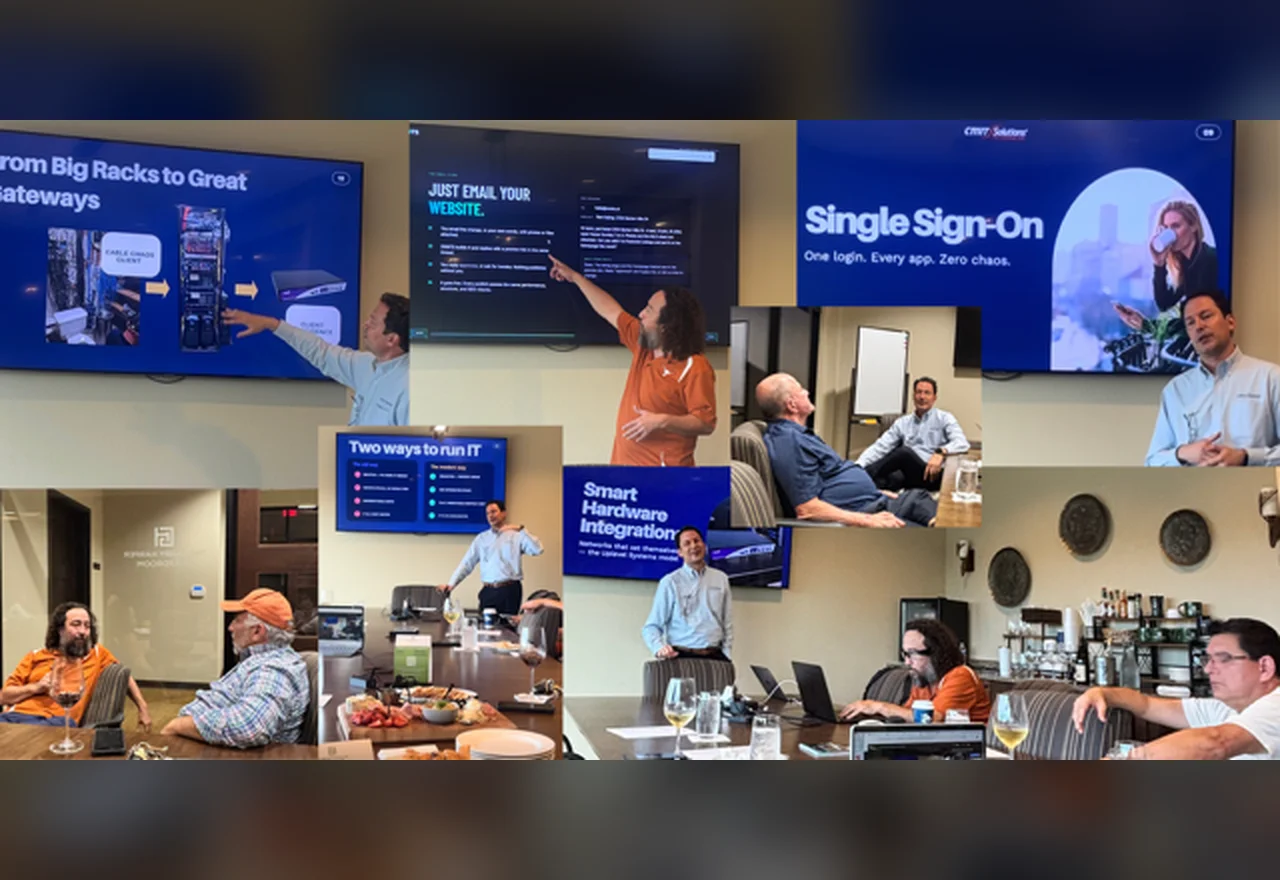
On October 28, business owners and firm leaders from accounting, financial services, and restaurants joined us at Great Hills Country Club for our Executive Gathering in Austin. It was a practical conversation about a challenge that affects nearly every growing company today: technology has become too complex, too reactive, and too risky to manage without a clear strategy.
Hosted by CMIT Solutions of Austin Central, the evening focused on a simple but urgent idea: IT should support growth, productivity, and security, not slow a business down. We covered single sign-on, cloud security, IT simplification, infrastructure integration, business productivity, and the growing role of AI in day-to-day operations. For local business owners, these are no longer “nice-to-know” topics. They are leadership topics.
The Problem: IT Complexity Is Quietly Hurting Austin Businesses
Many companies do not realize how much friction their technology creates until something breaks. What they do notice is this:
- Employees juggling too many passwords and logins
- Slowdowns caused by disconnected tools and systems
- Wi-Fi issues, unmanaged devices, and unreliable backups
- Unclear security practices around email, remote access, and AI tools
- Too much time spent reacting to problems instead of preventing them
- Unpredictable IT costs with no long-term plan
That led to one of the clearest messages of the evening: IT complexity is not just an IT problem. It is a business problem. When technology is fragmented, companies lose time, create avoidable risk, and make growth harder than it needs to be.
The Consequence: More Friction, More Risk, Less Growth
When a company runs IT in reactive mode, the consequences show up everywhere: more support tickets and recurring password problems, higher exposure to phishing and data loss, delays caused by poor system integration, less visibility into devices and users, and technology that feels like a cost center instead of a business asset.
The event emphasized a major shift in mindset. There are two ways to run IT:
- The old way: fix problems after they happen, manage too many vendors and disconnected systems, accept unpredictable costs, and treat IT as overhead.
- The modern way: prevent issues before they disrupt operations, build one integrated technology stack, create predictable monthly costs, and use IT as an accelerator for business growth.
Businesses that simplify and secure their technology move faster, make better decisions, and operate with more confidence.
The Solution: Simplify IT to Strengthen the Business
A central theme of the gathering was this: simple IT creates a stronger business. That came down to three key pillars.
1. Single Sign-On Reduces Chaos and Improves Security
Single sign-on (SSO) means one login for every core business application. In the presentation it was framed as “One login. Every app. Zero chaos.” For business owners, the value is immediate:
- Fewer password issues and fewer help desk requests
- Faster onboarding and offboarding
- Better control over who has access to what
- Lower risk of weak or reused passwords
- Stronger security when paired with multi-factor authentication (MFA)
For any Austin company looking to improve its cybersecurity and user access management, this is one of the clearest wins. We go deeper in how single sign-on replaces password sprawl.
2. Integrated Infrastructure Improves Productivity and Reduces Hidden Risk
Many businesses still run on patchwork infrastructure: aging equipment, unmanaged devices, dead Wi-Fi zones, inconsistent backup systems, scattered vendors, and limited visibility across the network. That creates daily friction and hidden operational risk.
An integrated network moves a company toward better Wi-Fi coverage, centralized device management, built-in backup, cloud monitoring, predictable support, and simpler vendor coordination. In short, your network should not be the reason productivity slows down. For Austin businesses that rely on remote work, cloud tools, and secure file access, modern infrastructure is not just a technical upgrade. It is an operational advantage.
3. AI Can Be a Competitive Advantage, If It Is Used Securely
The AI conversation was practical, not hype-driven: how can business owners use AI to save time, lower costs, and make better decisions without creating unnecessary risk? We reviewed examples such as meeting notes and summaries, email drafting and proposals, 24/7 customer chat tools, inventory and supply tracking, sales forecasting, pricing and market visibility, and dashboard reporting.
The message was clear: AI can improve productivity, but businesses need to use it intentionally and securely. Many teams already use AI tools informally, often without clear rules around customer data, internal information, or account access. The real question is not whether to use AI. It is whether your business is prepared to use it wisely, and that is where managed AI helps.
Why This Matters for Business Owners in Austin
Austin is one of the most dynamic business markets in the country. Companies here are growing, hiring, and adapting quickly, so local leaders need more than working technology. They need technology clarity. You do not need to become an IT expert, but you do need enough visibility to answer questions like these:
- Are our employees using secure access practices?
- Are our backups reliable?
- Is our Wi-Fi and device environment under control?
- Do we know who has access to what?
- Are we protected against phishing and email threats?
- Are our AI tools being used safely?
- Is our IT setup helping us grow, or quietly slowing us down?
These questions affect productivity, business continuity, client trust, and long-term resilience. That is why events like this matter: they help local executives make better technology decisions before a preventable issue becomes a costly disruption.
Download the Business Technology Health Wheel
As a practical follow-up to the event, we are sharing a simple self-assessment tool: The Business Technology Health Wheel. It is a 10-minute exercise that helps you evaluate how protected, organized, and ready your technology really is. It covers 10 essential areas:
- Safe and organized technology space
- Secure passwords
- Secure Wi-Fi
- Backups
- Secure access from home
- Help when you need it
- Centralized device management
- Email protection
- Secure use of AI
- Identity and access control
One of the most useful lines in the tool asks:
If this wheel were the tire of your business, would it help you move forward smoothly, or make the ride uneven and risky?
That is exactly the right question.
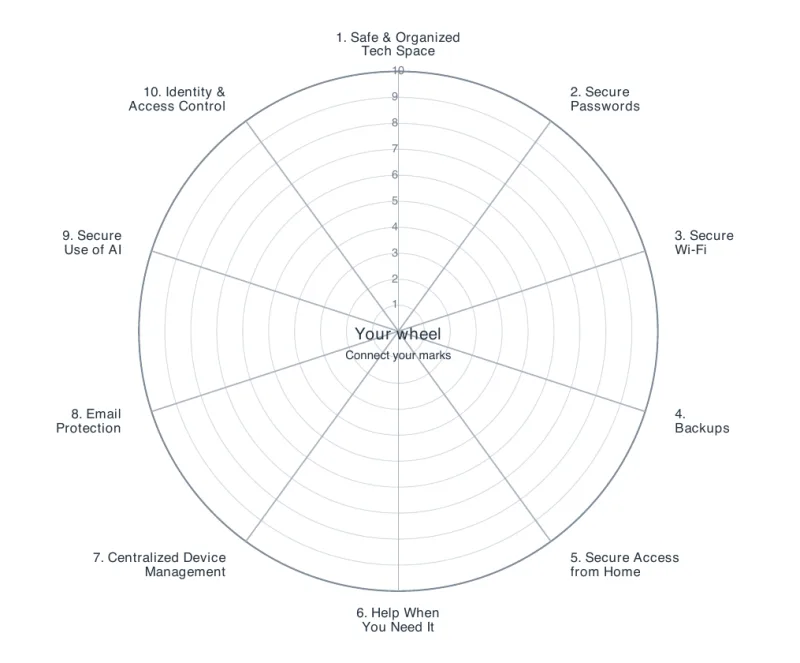
The Business Technology Health Wheel
A free, printable 2-page PDF. Mark each area from 1 to 10, connect your points, and see the shape of your technology wheel.
Key Takeaways
- IT complexity is a business problem: too many logins, disconnected tools, and reactive support quietly cost time and add risk.
- Simple IT is stronger IT. Single sign-on, an integrated network, and secure use of AI are three of the clearest wins for an Austin business.
- Start with visibility. The 10-minute Health Wheel shows your weakest areas, and an IT assessment turns them into a clear plan.
The Next Step: Schedule an IT Assessment with CMIT Solutions
If your business is dealing with technology friction, inconsistent support, growing security concerns, or uncertainty about how prepared your IT environment really is, the next step is simple: schedule an IT assessment.
We help local businesses evaluate where they stand and identify the most important opportunities to improve security, efficiency, and operational confidence. An assessment reviews identity and access controls, password and login practices, Wi-Fi and infrastructure reliability, backup readiness, email security, device management, remote work protections, safe AI usage, and your overall IT maturity.
Contact CMIT Solutions for an IT Assessment
Austin IT Support / CMIT Solutions of Austin Central
Website: austinitsupport.com
Phone: (512) 642-5457
Email: contact@cmitcatx.us
Schedule your business IT assessment and find out how secure, efficient, and future-ready your company really is. You deal with the owner, not a call center.